
When a plague of some sort isn’t pandemic in your immediate area, the communication of a family member’s death or terminal ailment can be difficult to handle. Who needs to know? When do they need to know by? How much communication are you responsible for? Does it matter if they know right now? Who is okay to lie to? Why lie at all? These questions intertwine, so firstly let’s discuss the three categories of people in everyone’s life: Personal, Professional, and Everyday.
When deciding to tell someone, it’s helpful to start by placing the individual into one of these categories. Personal and professional is pretty straight forward, personal being family, close friends, significant other, and professional being your boss, coworkers, subordinates, clients, the guy who takes your money when you bring your car in for that scary noise it’s suddenly making, etc. The Everyday category is a little more of a gray area. The Everyday people are like your Starbucks barista, not quite someone you’d call your friend, you don’t hang out together, and there is a level of professionalism between you formed by the monetary transaction for goods and services, but you’re both genuinely nice to each other, and when you wish them a Happy New Year you actually have feeling behind it. Sorting people assists the brain in readying relevant information when navigating the mental flow chart of Should I Tell Or Lie Through My Teeth, which will be addressed shortly.
Before that, let’s look at the “bell ringing” one has to do. When you learn of a parent’s impending death, or witness the parent’s expiration, you find yourself in a situation similar to our amicable businessman in the above Monty Python clip. You too must travel the streets with a bell, only shouting “Mom died” instead of “bring out your dead”. The question is, how far through the township must you travel? Do you have to make sure everyone heard?
This is difficult. In my experience, when my Mom died, my Dad took the mantle of Communicator, and I was left to occasionally tell an individual here and there. When he died, I found myself wandering around lost with a bell in my hands. I posted on Facebook, took out an obituary in the paper, called people who had visited enough for me to recognize their names in his phone. I failed to tell the neighbors – good thing they’re observant individuals. The reason behind this was that while we were friendly, we were by no means bosom buds. Of course you remember the Personal people, and the Professional people you make a point to tell or not tell, it’s the Everyday people that are missed. They simply aren’t high on the priority list.
Pro Tip #3: Do your future self a solid, get a list from the dying person of who to tell afterwards. He may be more likely to remember the neighbors.
Once you have passed the initial Bell Ringing of a death or terminal illness, things are calmer. You find yourself coming across isolated instances where the death may or may not need to be told to someone. This may be a Prompted instance, like when a person asks, “How’s your dad?”, or an Unprompted one when you realize the person doesn’t know and consider whether he should be told or not, given the person’s position in your life.
This is where my mental Should I Tell Or Lie Through My Teeth flow chart comes up, that I painstakingly made into virtual form for you all, my beloved readers.
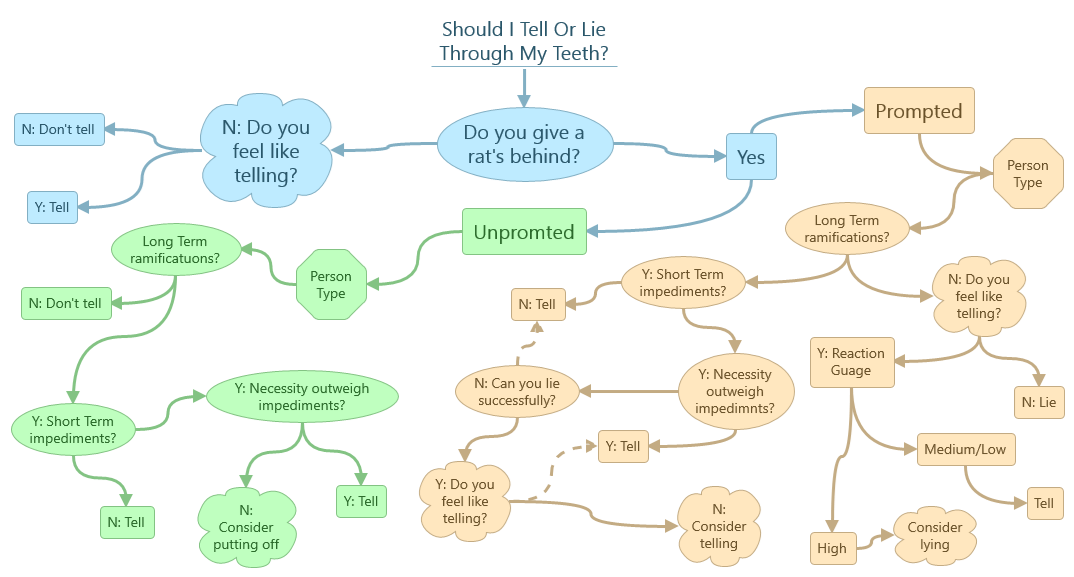
Flow Chart Terminology
To give, or not to give, a rat’s behind: While it can be beneficial to carefully consider who should know and the timing of things – i.e. giving a rat’s behind – your parent died, so really you can do whatever the hell you want – i.e. not giving a rat’s behind.
Long Term Ramifications: In chess, a successful player is a person who can see the future possibilities formed by her present moves. This applies here too. By taking into consideration the person’s relation to you and deducing where issues may arise later by not telling, these issues may outweigh your desire to not tell or short term impediments.
Example – If I did not tell the tax lady my Dad had used for over 20 years he died when I made the appointment, showing up solo on the decided day would have likely thrown her off her groove, jeopardizing the accuracy of the tax papers.
Short Term Impediments: These are constraints you will have to contend with in the present if you decide to tell.
Common ones include:
- Time Constraints – Telling takes extra time, so consider how much time you have to give. Are you on your lunch break? Do you need to get to an appointment? Does the post office close in 10 minutes and you still haven’t shipped Grandma’s present?
- Hunger Constraints – Telling takes time and energy, are your tanks filled up enough with both? If you only have 5 minutes left to inhale a sandwich, the first solid food of your day, before you continue with work, is telling your coworker your mom’s dead really that important?
- Environmental Constraints – Is it raining cats and dogs when you’re stopped by an old acquaintance in the street? Are there other people close by, who will feel compelled to give condolences too, adding to the time and energy drain? Are the other things you are doing more important at the moment?
Successful Lying: This is when you can lie – “she’s fine”, “they retired” – and the person takes it at face value or the conditions are such she is unable to inquire further (time constraint, work responsibilities, etc.) at the present, and the lie will not come back to give you more problems later (reference Long Term Ramifications).
Desire to Tell: This is the little reminder that your parent did die, so after all your analysis you realize you don’t want to tell, don’t. Lie your behind off. Unless it’s an institution like the Social Security Administration, lying is not condoned regardless of your internal state.
Lying and Truth Consideration: The situation is a bit of a mixed bag, your feelings may be at odds with what Lieutenant Commander Spock would recommend.
Reaction Guage: While only mentioned once in the chart, it is one of those factors when you’re “considering”. If you know the individual to be cool headed, you’re more likely to spend less time and energy telling her than you would someone who you know to tear up at the sight of a month old kitten.
Complicated enough for you? Don’t worry, in reality your brain usually makes the decision unconsciously in a split second. It’s cool like that. But, if you find you don’t even want to exert that much time and energy on deciding, you can always avoid all the hassle and say “He’s dead, Jim.” Letting the pieces fall where they may.
Pro Tip #4: The He’s dead, Jim. approach is recommended for advanced users and those with a high tolerance for “awkward” situations only.
Either way, at this point you’ve reached a decision which you must now execute.
Next time on Progeny of the Dead and Dying (mostly because this blog post is too long already): The Truth, The Lies, and The Uncomfortable.
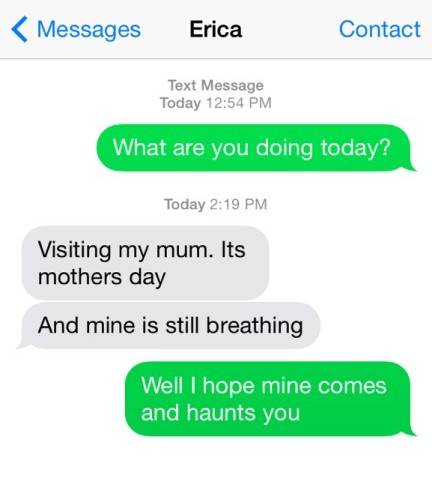
 Progeny of the Dead and Dying