I’m sorry. OMG REALLY why does everyone say that?

As the title implies, today’s post will be about automatic responses triggered by terminal news. The exact phrasing varies depending on the area, but I’d wager everyone has them in their lexicons. And along those vague lines of unsubstantiated hypotheses, I have no idea how contained the two responses we will be discussing shortly are to my specific locale. “I’m sorry” seems to be extremely popular across the country, but I have my suspicions, “OMG/Ohmehgawd/ohGod REALLY?” may be more of a Californian concoction.

Firstly, for those of us who have run across these responses already when delivering mortal tidings, let’s do a quick woo-sa session to help dissipate the feelings of irritation and bloodlust the mere mention of these phrases may well have already awakened.

All set? Great. Let’s look into the phrase, “I’m sorry”, and how it is used by both parties in the conversation.

“I’m sorry”

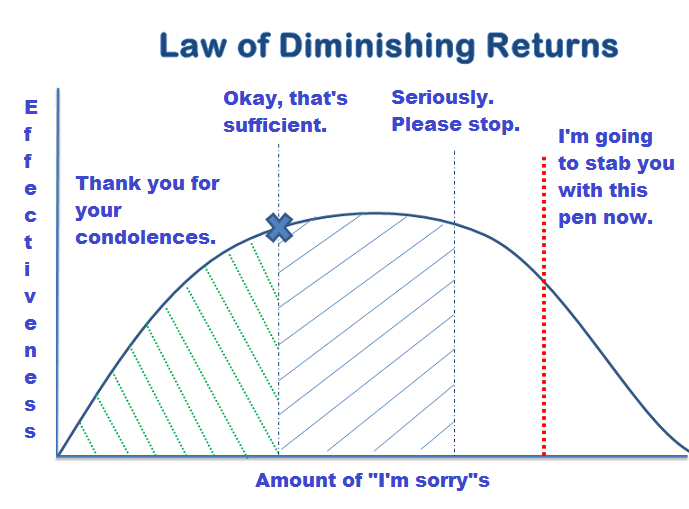
Like most things in this realm of dead and dying, “I’m sorry” usually comes from a very genuine place. Even when I spoke with the nice lady in India about my father’s cell phone line, the feeling behind her first words was sincere. Now the repeated, “We are sorry for your loss again”, undoubtedly a script she has been trained to say, was unnecessary. “I’m sorry”s are subject to the law of diminishing returns. The more you say it, the less impactful it is. Worse, not only will it become less effective, it can even have the opposite effect of what you were going for. Burying a person under a landslide of “I’m sorry”s is more likely to annoy/crush/suffocate someone than lighten his emotional burden. It can also imply insincerity in extreme cases.

law_of_diminishing_returns


But I’ve gotten a little ahead of myself. Here I am talking quantities when we haven’t even checked the quality out yet.

Pro Tip #12: “I’m sorry”s are subject to the law of diminishing returns. Limit the amount of times you reiterate your condolences to someone, especially when the terminal news is not the main topic of conversation.

“I’m sorry” sets the standard when people hear about someone’s hardship, although usually the person saying it has had nothing to do with the hardship occurring. This can cause the, “why are you apologizing, it’s not your fault”, response. For a while, I myself used this, because indeed it did not make sense to me why people were saying it. However, because for whatever reason “I’m sorry” is the standard to express empathy or sympathy for your situation, so that response throws people off, making them more uncomfortable. If “I’m sorry” is off the table, what is there? “Well uhh….at least you don’t have to visit hospitals anymore.”

Trigun

Trigun


Probably best to stick with, “I’m sorry”.

You may have noticed my strategic bolding of “both” earlier. If so, congrats on your killer observational skills. The reason I did this is because of a rather peculiar thing that can happen when someone says, “I’m sorry”. “Oh no, I’m sorry.” The progeny of the dead and dying finds itself apologizing right back.

Next time on Progeny of the Dead and Dying: Oh no, I’m sorry. OMG REALLY why is the one with the dead mom apologizing?

Criers to the left of me, Jokers to the right, here I am stuck talking death with you.

shock

Ranma 1/2


The Uncomfortable

When you tell someone anything, not just dead and dying news, which is out of the norm, out of the set communication patterns they are used to, it throws the brain for a loop because most of the time we aren’t actively listening. You will notice this by a blank look on the face as the brain reboots and sends the information through again, generally followed by a shocked face as the macabre information is properly processed.

Pro Tip #7: The time and degree of intensity for a shocked face will vary from person to person. Be sure to cherish the exceptional ones.

shocked face

Trigun


As I have said, people will react in different ways to news of a terminal illness or death, and conveniently for us I have broken the most common reactions down into five categories. You all know how I love to do that. And like the others, categories are not mutually exclusive.

The Crier

crier

Fullmetal Alchemist


This person is unique from the others in that she is not uncomfortable or unsure of what to do, because she lets her emotions guide her completely. This, however, can be uncomfortable for you, the teller. Depending on the category of person they are to you, extremely uncomfortable. Or maybe you just don’t like such displays of emotion. Along that vein you may also not like physical contact, such as hugging, like Alexis.

A coworker of mine Blitzed Hugged me while I was discussing this blog with my boss. She overheard about my parents’ early retirement, and being the loving person she is followed her emotional ques. Although surprising, the hug was highly appreciated and our coworker bond solidified that day.

Pro Tip #8: BE ADVISED – Criers are known for Blitz Hugging. Be prepared to defend your bubble.

The Sympathizer

This person can either be a great comfort or someone you would like to get away from as soon as social etiquette allows. Most of the time both types are genuine, and have dealt with the terminal illness of a loved one too. The difference is one will not shut up about it.

There are other factors that go into what makes a Sympathizer frustrating versus comforting besides the ability to recount everything ever in relation to death and dying. Remember Short Term Impediments? My internal state?

After my Dad died, I called my mobile provider to remove his phone line from my account. Now the first person I spoke with my father’s death worked to my advantage. When she had asked why I was cancelling a line, fully prepared to berate me with more questions and arguments to talk me out of it and into the latest model cell phone, my statement of death caused enough of a shock to get me propelled past all that red tape. Unfortunately, when I was transferred to the second person, for reasons I still do not fully understand, I encountered an overzealous Sympathizer.

sympathizer

Dragon Ball Z


He was very pleasant and helpful, but whatever process he had to do to complete my line severing took time; which he filled with repeated ardent statements of understanding for my position, as he had gone through the same with his mother not that long ago. Now while this was transpiring I was in a time crunch, had not yet eaten, and was not in the frame of mind to discuss such things, I just wanted the line dropped and to go about my day. So much so I could not even muster a polite “I’m sorry for your loss as well”. Partially because I knew it would sound listless, and partly because in my state his words seemed painted with indignation, at what exactly I don’t know, but it rubbed me wrong all the same. By the time I hung up, two and a half minutes after the process had been completed and the man had said his peace for the last time, I was thoroughly drained.

The moral of this story, girls and boys, is when you find yourself in the Sympathizer role, don’t go overboard.

Pro Tip #9: If you have advanced notice of a parent’s impending death, switch your cell phone, and whatever else you can into your name while the parent is still alive. This makes things much easier as mailing multiple death certificates is expensive and time consuming.

Pro Tip #10: When in the role of Sympathizer, keep it short and sweet until prompted otherwise.

The Faux Cool

faux cool (2)

Tenchi Muyo


The Faux Cool is the Fonz of the Happy Days crew. This person has been around the block, has seen some things. But don’t get me wrong, the Faux Cool can be just as awkward as the rest of them. There is keeping it cool when you’re told terminal news, and there’s hamming it up. I myself in my earlier years have been guilty of this. Additionally, I find being as cool as the other side of the pillow can still be awkward today, because when it’s someone not in my Personal category, I’m unsure how he will take to my Funeral Fonz.

On the flip side, when I am the teller, I like the person to be Faux Cool when it is someone not in my Personal category. They take the least time and energy to tell. Michael pointed out to me they are a rarity in the wild though, causing me to draw far too many similarities to my telling life and playing Pokemon. Sometimes you have to walk through tall grass to reach your destination, and of course you stumble upon two Sympathizers and a Bumbler along the way, but no Faux Cool, and that’s the one you’re holding out a Great Ball for.

The Bumbler

bumbler

Trigun


This person’s brain has finally processed your information, and has crashed all over again, making it send out nonsensical replies. Like the others, there are some sub categories to the Bumbler. There is the humorous Bumbler, his honest panic and jumbled words can be endearing as well as provide comedic relief. We like this kind.

Then there is the serious Bumbler. To quote Michael, “I hate this guy, my Mom just died and you’re making it worse”. You all may be thinking that ‘hate’ is a pretty strong word here, and it is, but let’s see a couple examples to get a better understanding.

“Well uhh…at least you don’t have to visit hospitals anymore.”

“Well uhh…at least you don’t have to drive her to the store anymore.”

You may be thinking these statements were said in jest, something a Joker might deploy, and you’re right. However, the difference is the serious Bumbler is not joking. In fact, he is confident in his statement of fact will be just as much of a comfort as an utterance of condolence would, which for whatever reason he decided not to go with. He genuinely thinks he’s helping.

bumbler

Black Butler


You will also notice the serious Bumbler generally has some key phrases, so be on the lookout for them. This will help you be ready for and mentally able to handle the abrupt spike in rage at the well-meaning person, instead of yelling, “Yes, because every time I drove her to the store I was thinking ‘man, I can’t wait for her to die so I can stop doing this’”, and decking him.

Pro Tip #11: Remember the serious Bumbler means well, and learn some relaxation techniques. Woo-sa readers, woo-sa.

The Joker

joker

Dragon Ball Z


Last but not least, the Joker. This person shares qualities with both the Bumbler and the Faux Cool. Her mind has lost its sense of up and down, freaks out, and makes an attempt to orientate itself by saying the enemy’s gate is death joke.

Remember my Dad’s bank lady? To recap, the last we left her I had told her he had passed back in May, it now being sometime in October. Her face blanked, brain rebooted, crashed and rebooted again. Gibberish began the conversation, a hug – which I offered, more on that in another post – followed by an exasperated

“In May! So long! Why didn’t you tell me?”

Why? Because you are the lady at the bank. An Everyday person. I have to look at your card to make sure I got your name right, but I do know your face and that you have always been very helpful and genuinely nice. As we all know though (for those who’ve been reading), not tops on the priority list.

“You could have sent a card.”

I didn’t send you a card because – wait what

joker wink

Lupin lll (Lupin the Third)


huh

Fullmetal Alchemist


Touche Bank Lady, touche.

Looking back, Michael and I have mused on how such a card would read had I indeed sent her one.

My Dearest Lady at the Bank,

Dad died.

Have a nice day,

Siobhan.

Spot on, I dare say.

Goku_Approves

Dragon Ball Z


Again, people react in all sorts of ways to the topic of death. It’s part of what makes us human. And apparently, what also makes us human, in my experience anyway, is set responses to tragedy.

Next time on Progeny of the Dead and Dying: I’m sorry. OMG REALLY why does everyone say that?

The Truth, The Lies, and The Uncomfortable.

Now that we have some sweet theme music, let’s get to it. For those just joining us, please firstly direct your attention to the previous post, as this one will make a whole lot more sense if you do.

The Truth

When telling the truth, you’re either playing offense or defense. Offense is when you are prepared to tell, you have a set plan of attack, a fair amount of the time this is when you are telling someone unprompted. Defense is when you can see a situation forming, and prepare for it in case it arises. Or worse, when an unanticipated, “How’s your dad holding up?” comes at you from out of nowhere. I call this getting ‘blindsided’.  When this happens, word-vomit tends to spew forth. Sometimes nonsense comes out – “He’s on getting fine”, sometimes the straight truth – “He’s on Hospice…yeeeaaahhh.”

A little over a month ago now, I went to the bank with Erica to do bank things. On the way, I realized I had not told the personal banker who had always helped my Dad over the years that my Dad had passed. So, I went on the Offensive and made a game plan if I saw her. After conducting my business with the teller, I was directed to a personal assistant that was not her, although I noticed her on the far end helping a client. At this point I referenced my internal flow chart (see previous post). I decided the short term impediments outweighed telling her: I was on a time constraint, she was with a client, the bank was busy and another personal banker was now waiting to help me. So I sat down and focused on my task at hand. Halfway through the matter, I was blindsided with a “Hey” from behind me and my friend. “How’s your Dad?” “Oh, he passed…back in May.”

What transpired afterwards, with the personal banker helping us watching in apprehension, will be discussed in The Uncomfortable portion, along with the varying reactions people will give you. Spoiler alert: the kind my Dad’s personal banker gave falls under The Joker category.

Pro Tip #5: No matter how well you plan, you will get blindsided. Accept this.

The Lies

Why lie? We’ve discussed this a good deal already, but it’s important to remember, especially for those who are on the receiving end of a lie. Various constraints such as time and energy, environmental situations, the relationship to the person, we know these. However, a large factor that was only touched last time is the teller’s internal state. A person may still be processing the terminal news or death, and may not be prepared to tell anyone. My boss told me of her friend, who was in a grocery store a day after her mom died, when an acquaintance bumped into her and asked how her mother was. The woman immediately replied “She’s fine” and kept on going. She was not ready to tell people the truth. It was nothing against the inquiring person. Now we can discuss the matter of whether her mother really is “fine” or not given her current state, and depending the woman is or is not lying about her mother, but I’d rather leave that for some other blog.

Don’t like lying? My friend Michael, if you remember him from the intro post, doesn’t lie to people, but also doesn’t tell the truth. What does this mean? While he wouldn’t lie to a person, he “wouldn’t leave myself open to tell the truth.” This technique has positives and negatives, and his story explains why.

When his Mom passed, he took a day off school but attended the next day, telling only a couple friends and his instructors. He had no intention of lying to anyone if a person asked why he had been absent, but since no one asked the news didn’t spread. The day progressed, and in the midst of a circle of people talking, a person laid a Your Mom Joke on Michael:

“My Mom just died.”

“Sure she did.”

“Yeah, she did.”

“Really?”

Does this instance sound familiar? This is the precedent for YMJ Comebacks situation #3. We will examine this person’s “Really?” comment a bit later, for now you can see where problems can arise. If it wasn’t for the YMJ though, Michael could have spent the day in peace, without questions he may not have been prepared for quite yet. Given the YMJ’s decrease in popularity, this is a sound option for those who have recently received a blow.

But for those okay with lying, let’s look at some examples! This is also handy for those of you who are not the progeny of a dead or dying parent. In the future you may catch a lie for what it is and make a mental note for your friend/coworker/relative/etc. The person may not be ready to tell you anything, and it may be nothing, a genuine statement not a lie, but you’ll increase your emotional IQ regardless.

“She’s retired!”

“They moved up North.”

“He’s taking it easy.”

“She’s hanging in there.”

“His pants fit again.”

As you can see, these are pretty innocuous at first glance. So don’t be hard on yourself if you don’t realize a person is hurting at first. What’s important is to try and give a person’s answer a real listen instead of treating it as a part of the greeting ritual.

Pro Tip #6: If a lie about a parent gets exposed, don’t panic. Your parent is dying/dead, do you really give a rat’s butt?

Pro Tip #6.1: If you do, tell the person why you did it and she will understand. Or lie again and say you told the person already. No decent human has the audacity to continually question a person whose parent is terminal/worm food/dust in the wind.

The Uncomfortable

When you tell people about a person’s, especially your parent’s, terminal state or expiration, they all react in different ways. This is because, largely, death and dying is a difficult subject for many. They are awkward with it, and because of that how they respond can be uncomfortable for both them and you.

That said, I’ve decided to pay further homage to the movie The Good, The Bad, and The Ugly by making this into a three blog post saga.

Next Time on Progeny of the Dead and Dying: Criers to the left of me, Jokers to the right, here I am stuck talking death with you.