
As the title implies, today’s post will be about automatic responses triggered by terminal news. The exact phrasing varies depending on the area, but I’d wager everyone has them in their lexicons. And along those vague lines of unsubstantiated hypotheses, I have no idea how contained the two responses we will be discussing shortly are to my specific locale. “I’m sorry” seems to be extremely popular across the country, but I have my suspicions, “OMG/Ohmehgawd/ohGod REALLY?” may be more of a Californian concoction.
Firstly, for those of us who have run across these responses already when delivering mortal tidings, let’s do a quick woo-sa session to help dissipate the feelings of irritation and bloodlust the mere mention of these phrases may well have already awakened.
All set? Great. Let’s look into the phrase, “I’m sorry”, and how it is used by both parties in the conversation.
“I’m sorry”
Like most things in this realm of dead and dying, “I’m sorry” usually comes from a very genuine place. Even when I spoke with the nice lady in India about my father’s cell phone line, the feeling behind her first words was sincere. Now the repeated, “We are sorry for your loss again”, undoubtedly a script she has been trained to say, was unnecessary. “I’m sorry”s are subject to the law of diminishing returns. The more you say it, the less impactful it is. Worse, not only will it become less effective, it can even have the opposite effect of what you were going for. Burying a person under a landslide of “I’m sorry”s is more likely to annoy/crush/suffocate someone than lighten his emotional burden. It can also imply insincerity in extreme cases.
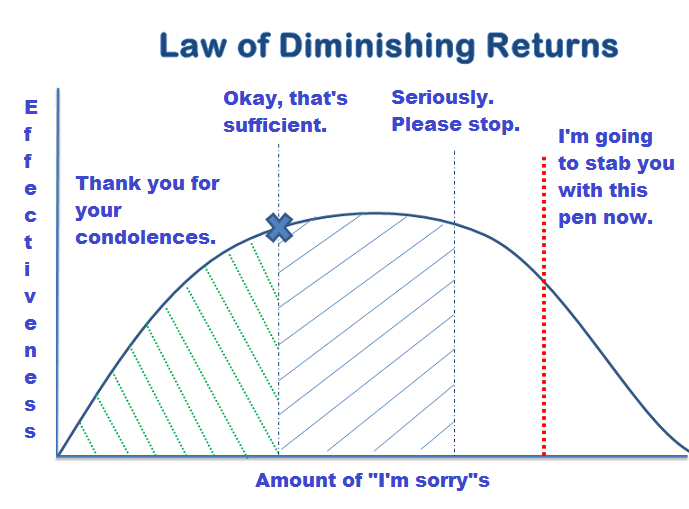
But I’ve gotten a little ahead of myself. Here I am talking quantities when we haven’t even checked the quality out yet.
Pro Tip #12: “I’m sorry”s are subject to the law of diminishing returns. Limit the amount of times you reiterate your condolences to someone, especially when the terminal news is not the main topic of conversation.
“I’m sorry” sets the standard when people hear about someone’s hardship, although usually the person saying it has had nothing to do with the hardship occurring. This can cause the, “why are you apologizing, it’s not your fault”, response. For a while, I myself used this, because indeed it did not make sense to me why people were saying it. However, because for whatever reason “I’m sorry” is the standard to express empathy or sympathy for your situation, so that response throws people off, making them more uncomfortable. If “I’m sorry” is off the table, what is there? “Well uhh….at least you don’t have to visit hospitals anymore.”

Trigun
Probably best to stick with, “I’m sorry”.
You may have noticed my strategic bolding of “both” earlier. If so, congrats on your killer observational skills. The reason I did this is because of a rather peculiar thing that can happen when someone says, “I’m sorry”. “Oh no, I’m sorry.” The progeny of the dead and dying finds itself apologizing right back.
Next time on Progeny of the Dead and Dying: Oh no, I’m sorry. OMG REALLY why is the one with the dead mom apologizing?
 Progeny of the Dead and Dying